🎨ArtArt History
🏠 Home🌐 中文
Art HistoryMASTERS
👼

Raphael

Original nameRaphael

One of the Renaissance "trinity," the embodiment of harmony and grace

Putting the Human Back at the Center · Renaissance & Baroque
PaintingMadonnasClassical Harmony

Who they are

Named with Leonardo and Michelangelo as the Renaissance "trinity," though far younger than the other two. He drew from all — Leonardo’s softness, Michelangelo’s force — fusing them into his own faultless harmony and grace. His Madonnas are gentle and serene, and his fresco The School of Athens gathers the philosophers of ancient Greece into a grand hall, the finest symbol of classical reason. He died young, at only thirty-seven.

Primary sourcesThe School of Athens (Vatican)The Sistine Madonna (Dresden)

Key stories

The School of Athens: Philosophers in One Room
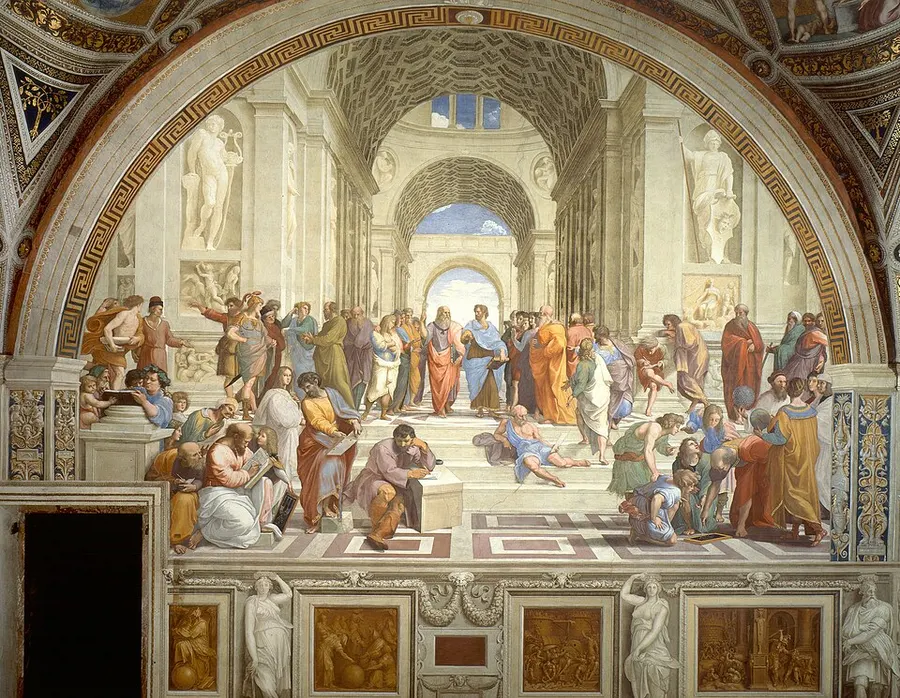
The School of Athens
The School of Athens · Raphael, 1509–1511, the Vatican

In the Vatican fresco The School of Athens, Raphael painted Plato, Aristotle, Socrates, Pythagoras, and other philosophers who spanned centuries and never shared a room, into a single grand vaulted hall — Plato pointing to the heavens, Aristotle gesturing to the earth, one asking of the ideal, the other of experience. With one painting, he took a "group photo" of the entire age of classical reason.

Relationships

Echoes today

Below are how modern works borrow or reinterpret this name or story — not the original material. The two differ, so keep them apart.

The cherubs at the foot of the Sistine MadonnaThe two chin-in-hand cherubs at the bottom of the painting, once cropped out, became one of the most popular decorative images in the world, seen on cards, packaging, and merchandise.

Appears in

Curiosity mailCurious about world civilization? Leave your email — we’ll tell you when there’s something worth a look.

Free · unsubscribe anytime · Privacy